

Important update for bottled water producers, natural mineral water manufacturers, food businesses, QA/QC teams and laboratories.
Malaysia's water quality requirements have been updated following the Food (Amendment) Regulations 2026 [P.U. (A) 48/2026].
The amendment was gazetted on 30 January 2026 and came into operation on 1 August 2026. Among other changes, it updates the standards for packaged drinking water, vended water and natural mineral water, as well as requirements relating to water used in food operations.
For businesses conducting routine water analysis, the amendment is an important reminder to review whether existing testing parameters, microbiological panels, acceptance limits and product specifications remain aligned with the latest requirements.
Which Schedule Applies to Your Business?
Before reviewing your laboratory testing programme, first identify the applicable Schedule:
|
Schedule |
Main Application |
|
25th Schedule |
Packaged Drinking Water & Vended Water |
|
25th A Schedule |
Standard for Water used in food-related operations |
|
26th Schedule |
Natural Mineral Water |
Understanding the distinction is important because the applicable requirements depend on the type and intended use of the water.💧
1. 25th Schedule – Packaged Drinking Water & Vended Water
The latest amendment revises the chemical and bacteriological standards for packaged drinking water and vended water.
Key Chemical Changes
Some notable changes include:
|
Parameter |
Previous Limit |
Revised Limit |
|
Aluminium (Al) |
0.04 mg/L |
0.10 mg/L |
|
Arsenic (As) |
0.001 mg/L |
0.005 mg/L |
|
Chloroform |
0.006 mg/L |
0.010 mg/L |
|
Gross Alpha Activity |
0.1 Bq/L |
0.5 Bq/L |
These changes mean businesses should review their existing product specifications and acceptance criteria rather than automatically continuing to use historical limits.
Microbiological Requirements – What Has Changed ?
The bacteriological requirements are another important area for businesses to review.
The previous 25th Schedule included parameters such as total coliforms, E. coli/thermotolerant coliforms, faecal streptococci, Pseudomonas aeruginosa, Clostridium perfringens and sulphite-reducing anaerobes.
The revised requirements change the applicable microbiological parameters and specifications.
|
Microbiological Parameter |
Previous Requirement |
Latest Requirement |
|
Total coliforms |
< 10 MPN/ 100mL; or < 4 CFU/ 100mL |
Not Detected in 250mL |
|
E. coli / thermotolerant coliforms |
Nil |
Not Detected in 250mL |
|
Faecal Streptococci |
Nil in 100 mL |
Not Detected in 250mL |
|
Pseudomonas aeruginosa |
Nil in 100 mL |
Not Detected in 250mL |
|
Clostridium perfringens |
Nil in 100 mL |
Removed |
|
Sulphite-reducing anaerobes |
Nil in 100 mL |
Not Detected in 50mL |
Why is this important ?
A laboratory test panel developed several years ago may no longer correspond exactly to the current regulatory requirements. Businesses should therefore review their existing microbiological testing programme and ensure that the parameters and acceptance criteria used for routine testing reflect the amended Schedule.
2. 25th A Schedule – Standard for Water
The 25th A Schedule should not be confused with the 25th Schedule.
It is relevant to water used in applicable food preparation, food manufacturing and food-related operations.
This can include businesses such as:
- Food and beverage manufacturers
- Ice manufacturers
- Central kitchens
- Restaurants and food premises
- Beverage production facilities
- Food processing operations
The Schedule covers physical, chemical and microbiological requirements for water. Businesses should therefore determine the application and intended use of the water before selecting the appropriate regulatory standard and laboratory test panel.
The 2026 amendment also introduces changes to Regulation 394 concerning certain water or steam used in food preparation, manufacturing or contact with food, including circumstances where further disinfection or equivalent treatment is applied.
3. 26th Schedule – Natural Mineral Water
The 26th Schedule applies specifically to natural mineral water and has also been amended under P.U. (A) 48/2026.
The amendments cover areas including chemical, bacteriological, radiological and labelling requirements.
Microbiological Requirements
The previous 26th Schedule specified requirements for coliform organisms and Escherichia coli. For example, the previous standard included a coliform requirement of not more than 10 per 100 mL by the multiple-tube method, together with membrane-filtration criteria, while E. coli was required to be absent.
The amended Schedule should therefore be used when establishing the current microbiological testing programme for natural mineral water.
|
Microbiological Parameter |
Previous Requirement |
Latest Requirement |
|
Total coliforms |
< 10 MPN/ 100mL or < 4 CFU/ 100mL |
Not Detected in 250mL |
|
E. coli / thermotolerant coliforms |
Nil |
Not Detected in 250mL |
|
Faecal Streptococci |
Nil in 100 mL |
Not Detected in 250mL |
|
Pseudomonas aeruginosa |
Nil in 100 mL |
Not Detected in 250mL |
|
Clostridium perfringens |
Nil in 100 mL |
Removed |
|
Sulphite-reducing anaerobes |
Nil in 100 mL |
Not Detected in 50mL |
The key takeaway for natural mineral water producers is that the current 26th Schedule should be used when determining the applicable microbiological test panel, rather than simply carrying forward an older testing specification.
Other Requirements to Review
The 26th Schedule amendments are not limited to microbiological testing. Natural mineral water producers should also review:
- Chemical requirements
- Radiological requirements
- Total dissolved solids (TDS)
- Mineral composition
- pH
- Source-related information
- Product labelling requirements
The amendment specifically updates requirements relating to natural mineral water and its labelling.
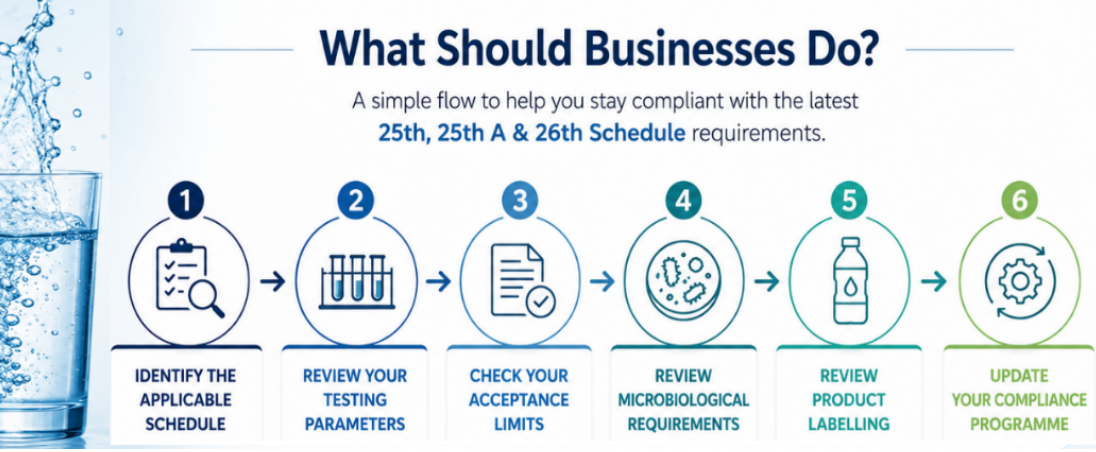
What Should Businesses Do ?
Businesses involved in water-related activities can follow this simple compliance flow:
How MY CO2 Can Support Your Water Testing Needs
Regulatory requirements can change over time, and an existing testing programme may not automatically remain suitable after an amendment.
MY CO2 provides chemical and microbiological water testing services for various water applications, supporting businesses in assessing water quality using recognised analytical methods and, where applicable, within the laboratory's accredited scope.
Our testing services support businesses involved in drinking water, packaged water, natural mineral water, food manufacturing, ice production and other water-related applications.
If you are unsure whether your current water testing programme remains appropriate, our technical team can assist in reviewing your water category, applicable parameters and laboratory testing requirements.
Need help with water quality testing or regulatory requirements?
Stay Updated. Test with Confidence.
Contact MY CO2 to discuss your testing needs.
The latest amendments are a timely reminder that water quality testing programmes should be reviewed whenever regulatory requirements change.
Whether you manufacture packaged drinking water, produce natural mineral water, manufacture ice, operate a food processing facility or use water in food-related operations, selecting the correct regulatory standard and testing parameters is an important part of maintaining product quality and compliance.
The question is not simply: “Have we tested our water?”
The better question is: “Are we testing our water against the latest applicable requirements?”
Disclaimer: This article is intended for general awareness and educational purposes only. It does not constitute legal or regulatory advice. Businesses should refer to the latest gazetted Food Regulations 1985 and consult the relevant authorities or qualified professionals when determining their specific compliance obligations.